What are the ripple effects of an AI efficiency gap for Canadians?
AI and its impact on modern life continue to drive global discourse, with a central theme being the link between AI and productivity. An ISED report released in December 2025 and presented by ISED and Canada's national AI centres, Amii, Mila, and Vector, reveals that Canada faces significant productivity challenges and lags behind its G7 peers in the primary tool for closing this gap — AI adoption.
What are the ripple effects of this efficiency gap for Canadians?
In a recent issue of the Globe & Mail, members of Amii’s executive team and board discussed the importance of AI adoption, its impact on Canadian productivity, and how these effects reach into our daily lives.
If we use the best tools to produce goods and services, we can positively impact the productivity and affordability challenges currently facing Canadians.
Cam Linke
Amii CEO
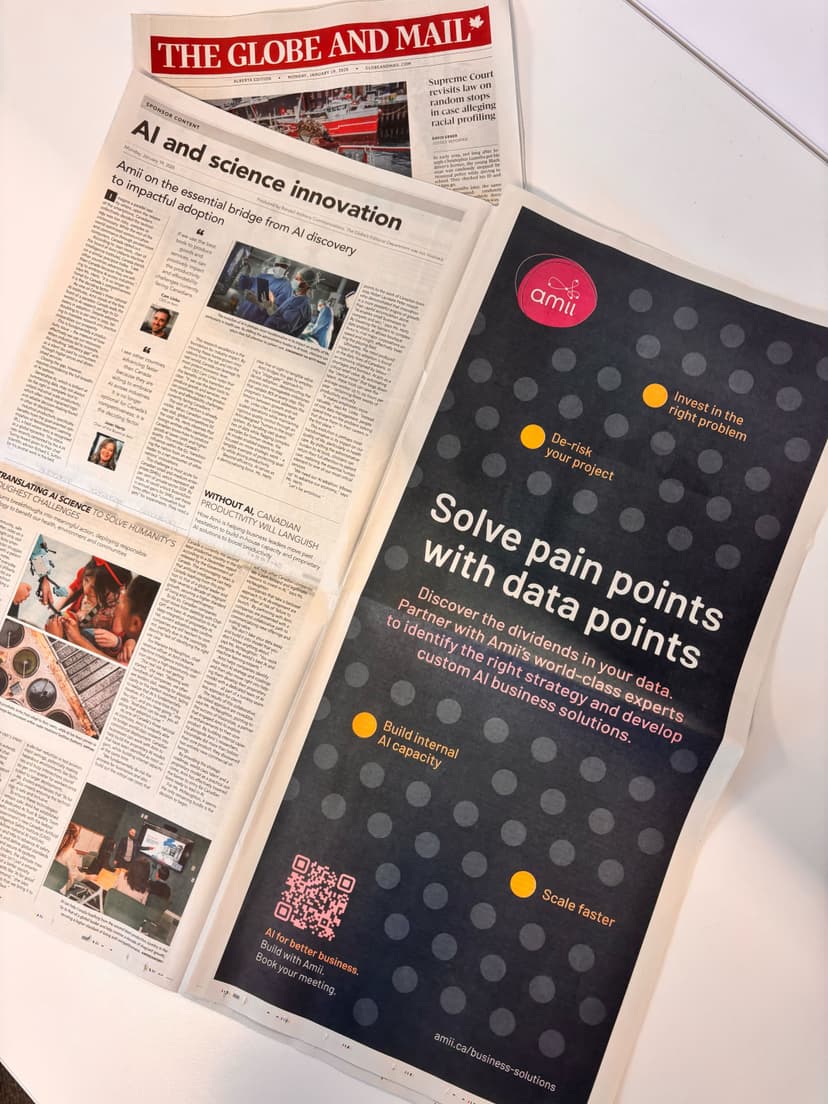


Amii on the essential bridge from AI discovery to impactful adoption
Amii CEO Cam Linke and Board Chair Joan Hertz highlight a critical paradox: while Canada leads the world in AI research, we continue to lag behind our G7 peers in adoption. To secure long-term prosperity and address the national productivity crisis, Canadian industries must move beyond research and begin integrating these powerful tools into daily operations. The article highlights how Amii is bridging this "efficiency gap" through three strategic focuses:
Securing Economic Competitiveness: As Joan Hertz notes, AI is no longer optional; it is the deciding factor for Canada's standing on the world stage. By moving homegrown innovations from the lab to the real world, we can ensure Canadian companies lead the market rather than becoming net consumers of foreign technology.
Empowering SMEs and Leveling the Playing Field: Small and medium enterprises (SME) represent nearly half of Canada's private-sector GDP. To de-risk adoption for these firms, Amii employs a pragmatic "stage-gate" approach that provides a clear line of sight to ROI, allowing boutique companies to rival major corporations in speed and insight.
Enhancing Productivity and Quality of Life: Beyond efficiency, AI acts as a critical relief valve for a workforce strained by burnout. By automating rote administrative tasks, AI tools can reclaim up to an estimated 125 hours per worker annually, allowing professionals in sectors like healthcare to refocus on the essential human elements of their roles.
Read the full article here.
Without AI, Canadian productivity will languish
Despite current productivity challenges, AI offers a pathway to reverse stagnant growth and secure a competitive edge. Marlene McNaughton, Amii’s Chief Revenue Officer, argues that to bridge this gap, Canadian businesses must move beyond basic exploration toward the integration of proprietary AI solutions. She explains how Amii helps leaders navigate this transition through key focus areas:
De-risking the Innovation Process: By moving away from a "wait and see" approach, Amii provides a proven framework that helps companies identify high-impact use cases and begin iterative development with confidence.
Building In-House Capacity: Rather than outsourcing innovation, partners work alongside world-class machine learning experts to develop internal talent and maintain full ownership of their AI roadmap.
Translating Research into Commercial Value: From strategic roadmapping to the deployment of custom models, Amii’s turnkey approach helps firms turn technical potential into tangible products and scaled operational value.
Read the full article here.
AI for Good and for All
Translating AI science to solve humanity’s toughest challenges
Meanwhile, Amii’s Chief Delivery Officer, Stephanie Enders, shared insights on how AI tools can advance human and social impact. Referencing Amii’s vision of “AI for good and for all,” Stephanie Enders focused on tangible applications that improve daily life, health, and the environment. By moving breakthroughs from the lab into the community, Amii serves as a steward of responsible innovation through three primary pillars:
Restoring Human Connection in Healthcare: Through tools like AI-driven medical scribes and adaptive bionic limbs, Amii is reducing administrative burdens and technical barriers, allowing clinicians to focus on patients and empowering individuals with limb loss through intuitive technology.
Solving Critical Infrastructure & Environmental Challenges: Using Reinforcement Learning, Amii is addressing essential needs in remote areas, such as automating water treatment processes to ensure consistent access to clean water in regions facing technician shortages.
Committing to Trust and Safety: To ensure innovation remains inclusive and secure, Amii’s dedicated AI Trust & Safety Team collaborates on global standards and research with national partners, ensuring AI systems are built on a foundation of security and ethics.
Read the full article here.

Additional Reading
Insights from ISED & the National AI Centres
Interested in learning more about AI adoption among SMEs? Dive into the recent report: Artificial intelligence adoption by small-and-medium sized enterprises: Insights from G7 case studies and Canada's experience.
Released in late December 2025, the report is a close examination of SME AI adoption across G7 nations and is presented by the Government of Canada’s ISED (Innovation, Science, and Economic Development Canada), and Canada’s national AI institutes, Amii, Vector and Mila.