Instead of sending crews out to dangerous and remote areas, Carson can now estimate stream classification much faster and more safely, achieving an average 75% accuracy with the right data.
These classifications are required by government regulators: they set out buffer zones to prevent heavy equipment and development from damaging the sensitive waterways.
The AI project undertaken with Amii was critical for environmental protection and stewardship, worker safety, and industry efficiency.
Carson Integrated worked with Amii to select and scope the right challenge that machine learning could best help solve; worked with Amii to build a bespoke new model; and then funded other companies in the forestry sector to go through the same strategy process to identify their best machine learning projects.
For the past 20 years, Carson Integrated has navigated the rugged and remote corners of western Canada, mapping out the terrain and providing valuable geographic information to clients in forestry, oil and gas, and other industries.
Now, the Edmonton-based environmental consultancy firm is exploring how artificial intelligence and machine learning (ML) can help reduce the difficult, sometimes dangerous work of stream measuring, offering a valuable competitive edge for its clients.
"We see AI as being a sharp tool in our tool set,” says Lorne Carson, founder and president.
When Carson started his company in 2006, it was as a single-person consultancy drawing on his years of experience in forestry. Since then, the company has grown to offer clients a variety of services in forestry management, as well as environmental and ecological services.
One of their main areas is in providing geographic information system (GIS) data, which includes information on the terrain, waterways, vegetation, and natural features in an area. Carson says they conduct their work in northern Alberta’s heavily-forested “Green Zone,” using aerial images, satellites, and boots-on-the-ground manual measurement.
“It's really hard work in some of the most remote parts of the province,” Carson says.
“We wanted to find a way to use machine learning to reduce the amount of time and effort of sending our field crews out into the forest. So we reached out to Amii about how we could move forward.”
"If you have an organization like Amii on your side, you'll be successful."
Lorne Carson
President and Founder, Carson Integrated


Streaming data
An important part of the GIS data that Carson offers its clients is stream classification. In Alberta, streams are classified into one of five categories, depending on factors like width and whether the stream is permanent or ephemeral.
Government regulations protect the areas around streams, such as establishing buffer zones where heavy machinery can’t operate. And different classifications of streams have different buffer zones.
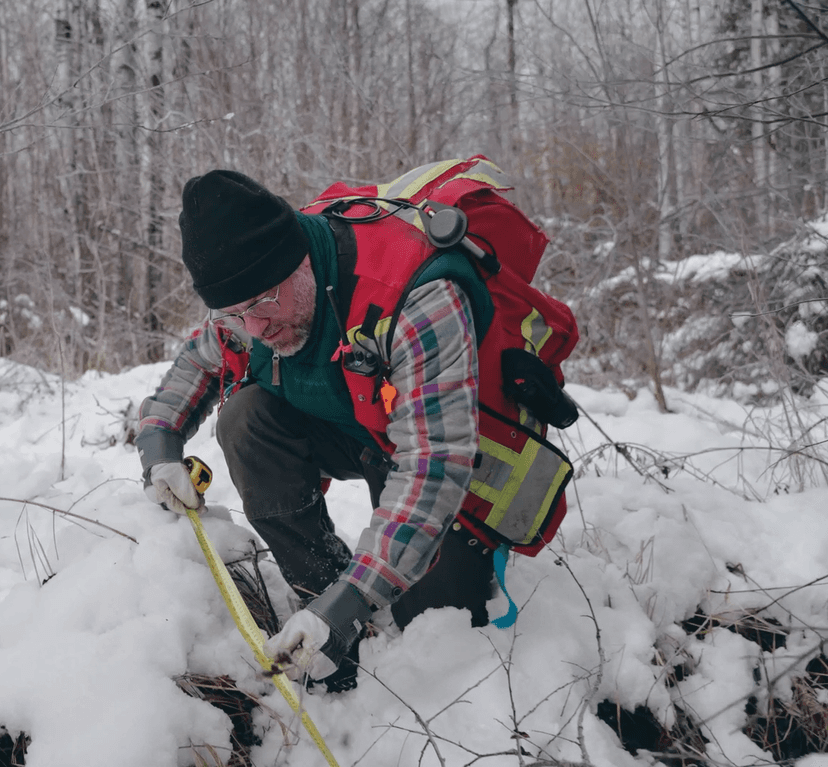
There are hundreds of thousands of streams in Alberta, many of them in remote, wild areas. And while there are maps (as well as AI models) that can be used to find out where streams are, Carson says there is no easy resource that maps out what their classifications are. Traditionally, the best way to find the classification of a stream is also the most time-and labour-intensive: sending people out to find the stream, walk along it, and take a measurement of its width every 50 metres.
Not only is that a lot of work, but it can also be a safety risk. Work crews have to travel to remote areas and deal with the Canadian wilderness, and all the difficult terrain and wildlife that comes with it. And if something does go wrong, Carson says, it can be hard to get people out.
“If there's an issue out there, if there's an incident where somebody gets hurt, it's very challenging terrain or very challenging areas to mount a rescue,” he says.
When the company first approached Amii, they weren’t specifically trying to solve the problem of classifying streams. But they did know that they wanted to explore what benefits machine learning could have for their business.
“They don't want a machine learning output. They want something that they can use in their business."
Golnaz Mesbahi
Amii Machine Learning Resident
Putting data to use
Another asset that Carson Integrated has is data. A lot of data. Jerome Cranston is the company’s Innovation Project Manager and has decades of experience using geospatial data. He says that Carson has a library of information that they’ve gathered over the past 20 years: not just stream measurements, but also remote sensor data, including LIDAR (Light Detection and Ranging), satellite imaging, and radar detection.
They approached Amii to see if machine learning could help them make the best use of their data.
"That merging of expertise—our expertise in natural resources with their expertise in machine learning and AI—is a really nice synergy,” Cranston says.
Carson Integrated signed up to Amii’s AI Strategy Package process, which starts with a workshop. It’s a collaborative process, where the company and Amii’s machine learning experts work together to discuss the company’s business needs and brainstorm on possible machine learning solutions. Instead of taking a pre-made ML solution and trying to make it fit the problem, the approach is responsive to an organization’s unique needs and focuses on custom-made solutions.
Through their work with Amii, Carson Integrated identified stream classification as the most high-value problem that they could tackle.
"It was important for us to work with an organization that we could meet face to face and have hands-on training,” Carson says.
Once the problem was identified, Carson took advantage of Amii’s unique client development product, called an Advanced Technology Project, to build a solution. They worked closely with Golnaz Mesbahi, an Amii machine learning scientist who was hired and dedicated specifically to their project.
Working with the 20 years of data that Carson Integrated had collected, Mesbahi began building a model that could predict what a stream’s classification would be. After cleaning and processing the data, she began to experiment with different features in the data to discover what type of information would make for the most accurate predictions: everything from temperature to the ruggedness of the surrounding terrain to the heights of the tree canopy in the area.
Eventually, she found that focusing on the size of the catchment outlet — the low point in the terrain where rain and runoff collect near the end of a stream — was a key datapoint. That information, along with other data points, allowed Mesbahi to build the prediction model that could provide insights that
Carson Integrated could take action on. It was an iterative, back-and-forth process, working in close collaboration with the company to make sure the model fit their business needs.
“They don't want a machine learning output. They want something that they can use in their business,” Mesbahi says.
The resulting model is able to estimate stream classification with an average balanced confidence of 70- 75 per cent, with some predictions reaching as much as 90 per cent. It’s a promising start, and one that Carson is looking to improve in the future by integrating new data and further refining the model.
But even with the current iteration of the model, Carson has begun to see some real-world benefits. The model has reduced the need for boots-on-the-ground measurements. Cranston says the stream predictions allow Carson Integrated to provide its clients with forewarning of what kinds of streams they might encounter in an area, giving far more clarity when it comes to planning for oil and gas, forestry, or building infrastructure in remote areas.
As well, the predictions allow the company to make better use of its work crews, saving them for areas where the predictions have low confidence. That means workers spend less time in the difficult, dangerous remote terrain, measuring streams manually.
“The more we can predict things confidently, the more powerful our whole GIS becomes,” he says.

Looking to the future of forestry
For Lorne Carson, his initial partnership with Amii is a big step, but only the first one. Forestry is an
extremely competitive industry, and Carson has built a reputation for embracing innovation to keep ahead of the game.
He says the success of the stream classification model shows the immense potential that machine learning offers in the forestry industry, and that using AI is not optional for companies that want to stay competitive in the future.
"If we want to be successful for the long term, we have to be bringing innovative solutions to the table with our clients to help them improve,” he says.
In fact, Carson believes it so strongly that the company paid for some of Carson Integrated's clients to do a training and brainstorming session with Amii in late 2025, so that they could increase their AI literacy.
Carson says the company plans to build on the success of their partnership with Amii. In addition to continuing to refine the stream classification prediction model, they are already exploring other ways that machine learning can be used in their business.
As the technology of artificial intelligence continues to develop, he says that companies that don’t have the knowledge and experience to make full use of it will be left behind.
“I would say reach out to Amii and start a relationship. Then start to think about how it can be used to improve your business or the industry that you work in.
If you have an organization like Amii on your side, you'll be successful,” he says.