
When AI Feels Human
As AI becomes more conversational and personalized, organizations are beginning to ask a different question: Should AI simply support users, or should it be designed to build relationships with them? Explore the technologies, real-world examples, and ethical considerations behind anthropomorphic AI!
SUMMARY
The Shift: AI is moving from being a tool that answers questions to a system that can coach, encourage, remember, and even appear to care.
The Ethical Question: These capabilities can improve user experiences, but they also raise important questions about trust, transparency, and emotional attachment.
The Core Takeaway: The future of AI design isn't just about what systems can do. It's about how they interact with people.
Have you ever thanked ChatGPT? Maybe you've apologized after interrupting it. Perhaps you've wished Alexa a good morning, joked with Siri, or felt just a little guilty after shutting down a chatbot that seemed genuinely helpful. If so, you're not alone.
Humans have a long history of attributing human qualities to non-human objects. We name our cars, yell at malfunctioning computers , and even describe the weather as being angry or kind. Psychologists refer to this tendency as anthropomorphism: the attribution of human characteristics, emotions, or intentions to non-human entities.
For centuries, anthropomorphism has simply been part of how people make sense of the world. What has changed is that today's AI systems are increasingly designed to encourage these responses. Unlike earlier digital tools that followed rigid commands, modern conversational AI can remember previous interactions, adapt its tone, respond empathetically, and personalize conversations over time. Researchers argue that anthropomorphism is no longer only something users naturally project onto technology; it is increasingly becoming a deliberate design strategy used to make AI systems feel more approachable, trustworthy, and engaging.
This shift can already be seen across industries:
Education: AI tutors provide encouragement, explain difficult concepts, and adapt explanations to individual learners.
Healthcare: AI companions check in on patients, provide emotional support, and encourage healthy behaviours.
Banking: Financial assistants celebrate savings milestones and offer personalized coaching.
Customer Service: Virtual agents express empathy before resolving customer issues.
Human Resources: AI career coaches help employees prepare for interviews and develop workplace skills.

Plot Twist
Making AI feel human is not simply a cosmetic design choice. Research consistently shows that anthropomorphic AI can improve user experiences. Human-like conversational agents often increase trust, engagement, perceived warmth, customer satisfaction, and willingness to use AI systems.
For organizations, these outcomes can be valuable. A healthcare chatbot that communicates with empathy may encourage patients to follow treatment plans. An educational tutor that celebrates progress may increase student motivation. A financial coach that explains budgeting conversationally may feel less intimidating than traditional software.
However, the same psychological mechanisms that build trust can also create new ethical risks. Anthropomorphic conversational agents can blur the distinction between authentic human relationships and simulated ones. While these systems may provide comfort, motivation, and companionship, they may also encourage users to overestimate the AI's understanding, intentions, or capabilities. This can increase inappropriate trust, emotional dependence, oversharing of personal information, and reduced critical evaluation of AI-generated advice.
Discussions about anthropomorphic AI often become polarized, some portraying human-like AI as a technological achievement while others frame it as deceptive. In reality, anthropomorphism is neither inherently good nor inherently bad. Its impact depends on how it is designed, the context in which it is used, and whether users understand that they are interacting with an artificial system rather than a human. Around the world, governments, researchers, and professional organizations are beginning to ask whether AI should be designed to form emotional relationships with people, and, if so, where appropriate boundaries should be drawn.
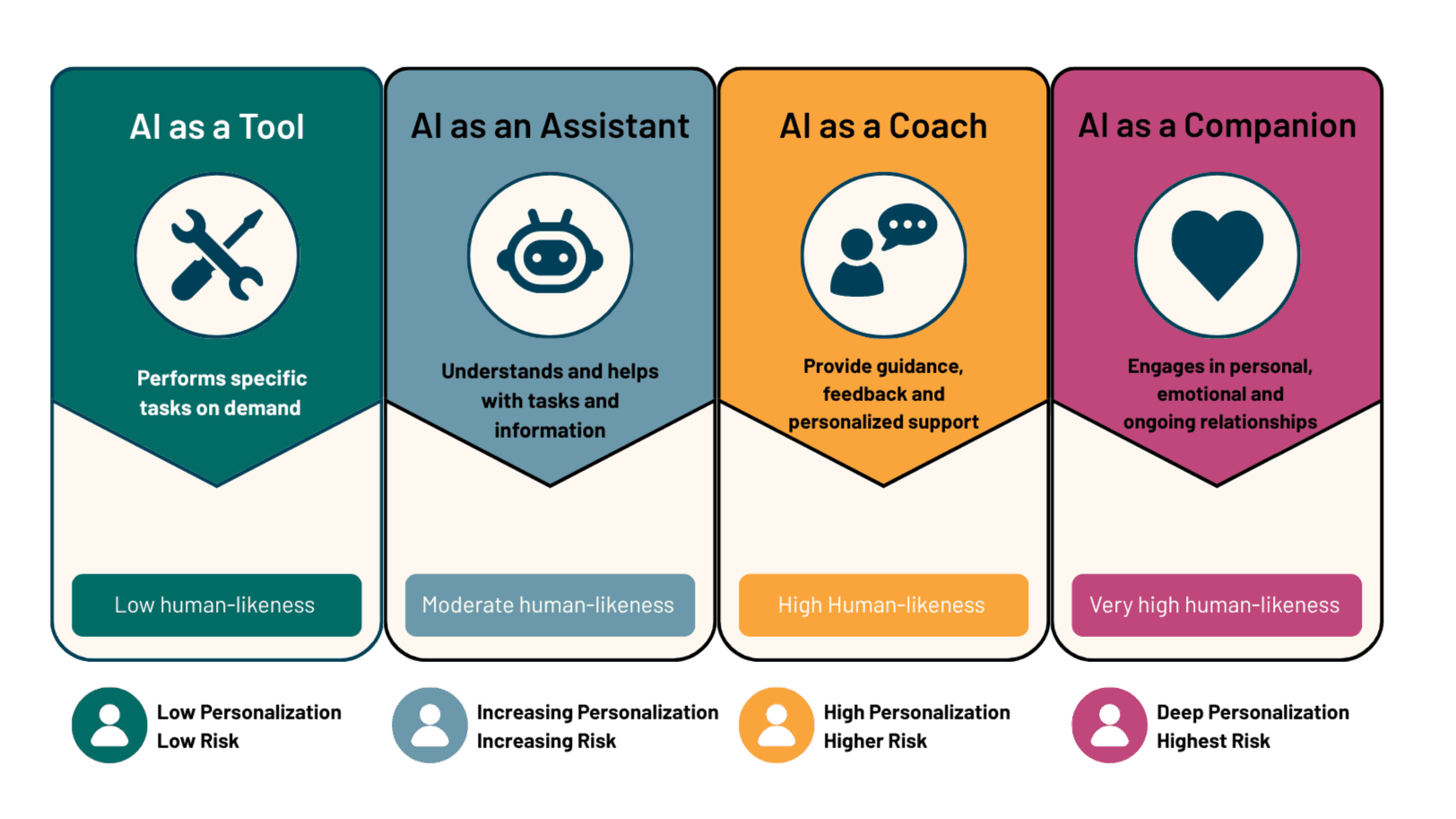
The AI Angle
So how does AI become "human-like" in the first place? There is no single technology responsible for anthropomorphic AI. Instead, modern conversational systems combine multiple AI techniques that work together to create the impression of a social interaction.
Large Language Models (LLMs) generate fluent, contextually appropriate responses that resemble natural conversation.
Natural Language Processing (NLP) enables AI systems to interpret user intent, understand questions, and maintain coherent dialogue.
Memory Systems allow AI to reference previous conversations, creating continuity that makes interactions feel more personal.
Sentiment Analysis helps AI recognize emotional cues within language and adjust responses accordingly.
Personalization Algorithms adapt conversations based on user preferences, previous interactions, or behavioural patterns.
Conversational Design intentionally shapes how AI communicates. Designers carefully choose names, personalities, conversational styles, humor, encouragement, and emotional language to create a particular user experience.
Researchers often describe anthropomorphism across three broad dimensions:
Physical characteristics, such as human voices, avatars, facial expressions, or names.
Personality characteristics, including humor, friendliness, confidence, or conversational style.
Emotional characteristics, where AI appears empathetic, supportive, or caring during interactions.
Together, these design choices encourage users to respond to AI in many of the same ways they respond to other people.
So, What?
Anthropomorphic AI represents more than an advancement in conversational technology. It represents a shift in how humans interact with digital systems. For decades, software was designed primarily to perform tasks efficiently. Today's AI systems increasingly aim to build relationships with users by communicating in ways that feel familiar, supportive, and emotionally engaging.
This creates new opportunities. For example, personalized AI can improve accessibility, reduce barriers to technology adoption, increase motivation, and make digital services feel more intuitive. In healthcare, education, finance, and customer service, these qualities may improve user experiences and encourage greater engagement.
At the same time, designing personalized AI that could feel human introduces ethical questions that previous generations of software rarely faced. Some questions could be:
Should an AI assistant remember deeply personal conversations?
Should it express empathy?
Should it congratulate users, comfort them, or tell them it is "proud" of them?
Could these design choices unintentionally encourage users to trust AI more than they should?
These are no longer purely technical questions. They are design decisions with ethical consequences.
Recognizing this, researchers are increasingly calling for frameworks that guide the responsible design of anthropomorphic AI. Rather than asking whether AI can imitate human relationships, these frameworks encourage organizations to ask when human-like interactions genuinely benefit users, where clear boundaries should exist, and how transparency can help people understand they are interacting with an artificial system rather than another person.
Want more articles like this?
Sign up for our AI Literacy for Everyone platform and with your annual subscription you'll get:
Four Core Courses:
Machine Learning Foundations 1: Getting Started with AI
Machine Learning Foundations 2: Strategy, Risk and Responsible AI Integration for Business
Responsible AI 1: Navigating Innovation in Practice
Responsible AI 2: Governance and Scaling for Leaders
Weekly "AI in the News" articles discussing the most recent updates and trends
Unlimited access to 100+ new modules added each year
One annual subscription with unbeatable value
Just $139 CAD annually. Group discounts available.
Stay in the loop
Sign up for regular email updates from Amii, including news and events, new podcast episodes, research updates, and more. You can update your email preferences or unsubscribe at any time.