
What is Jev? And How Does it Differ from LLMs?
Free preview article from Amii's AI Literacy for Everyone platform. Written by Amii's AI Literacy Team.
Summary
Discover Jev, a System One model designed to execute fast, structured, and low-cost decisions without the heavy overhead of traditional LLMs. Explore how Jev’s decision primitives deliver calibrated probabilities rather than generated text to streamline automated workflows. Discover how Jev’s rapid parallel evaluation can optimize your department's processes.
Overview
Using a Large Language Model for every small decision can be like hiring Einstein to change your light bulb. The task may require a basic understanding, like turning off the switch before you touch the light bulb, but only uses a small part of Einstein's capability.
In many current workflows, Large Language Models (LLM) like Claude or ChatGPT are over utilized to make small decisions repeatedly. For instance, inputting emails or utilizing an agent to ask if this message is spam, or if an email needs a reply. These short yes, or no questions is what Jev is designed for.
Jev operates on a System One Model, this model is designed to make fast decisions that are automatic and essentially intuitive, a yes or a no. This System One Model emphasizes fast, focused judgements within a larger workflow (TypeSafe AI, 2026). Jev’s primary role is not to emulate human-like reasoning, like LLMs but to provide quick seamless decisions with a probability and confidence value assigned to them.
Jev vs. Traditional LLMs
Where an LLM receives context and produces an answer, Jev receives the same context, and outputs in a structured way, evaluating decisions in parallel.
Jev: | LLMs: |
|---|---|
Outputs structured values | Outputs generated text |
Response time is 70ms-500ms | Response time is 3-329 seconds |
Input tokens: $0.042 | Input tokens: $0.20-$10 |
Parallel sampling, generating all outputs in a single query | Sequential sampling, generating a single token at a time, one after another |
Reinforcement Learning for Calibrated Decisions (RLCD) | Reinforcement Learning with Human Feedback (RLHF) |

Example
For instance, when an LLM receives a question about an email, such as:
Is this message spam?
Which team should receive this request?
Does this email need a reply?
Which tool should an agent use next?
The LLM will provide a response that will write, design, summarize and the results when all you needed was a yes or no answer. Jev is designed for these tasks, it takes natural-language input and returns structured decisions with concurrent probabilities.
Jev supports three decision primitives for probabilities:
Jev Decision Primitive: | Identifies: |
|---|---|
✅ Choice: Selects from known options | ✉️ Team classification |
✅ Score: Places the input on an ordered scale | ↕️ Low, Medium and High classification |
✅ Noul: Evaluates yes-or-no condition | 💯 Returns the probability that is true |
These outputs can feed directly into software that classifies information, prioritizes work, or selects the next action. Jev provides probabilities within its answer, which are a useful feature, they allow software to account for uncertainty. An application can act automatically when the evidence is strong, and request more information when an ambiguous or less certain answer to a person or another model.
For these probabilities to be meaningful, they have to first be calibrated, for example, across many predictions assigned an 80% probability, the predicted outcome should occur approximately 80% of the time. TypeSafe AI has trained Jev towards this objective but this calibration does not guarantee that any individual decision is correct.
For example, an email-triage app built with Jev demonstrates how these ideas work together. When this Jev built app receives an email, it will evaluate the message against three predefined questions:
Question | Jev Result Probability | What it Means |
|---|---|---|
What kind of email is this? | Meeting: 78%; Request: 14%; Spam: 8%; FYI: 0% | The Jev model selects “meeting” as the most likely category. |
How urgent is it? | This week: 80%; Today: 12%; Ignore: 8%; Right now: 0% | The Jev model places most probability on handling it this week. |
Does it need a reply? | 70% probability of “yes” | The Jev model leans toward a reply being needed. |
Jev In Action
Jev is not an LLM – and one of TypeSafe’s strongest claims about Jev is that it is unable to hallucinate. To understand this claim, we need to distinguish between producing an invalid output and making an incorrect decision. Jev’s limited outputs are defined in advance, for example, in this sample Jev project, four types of emails have been defined: meeting, request, fyi, and spam.
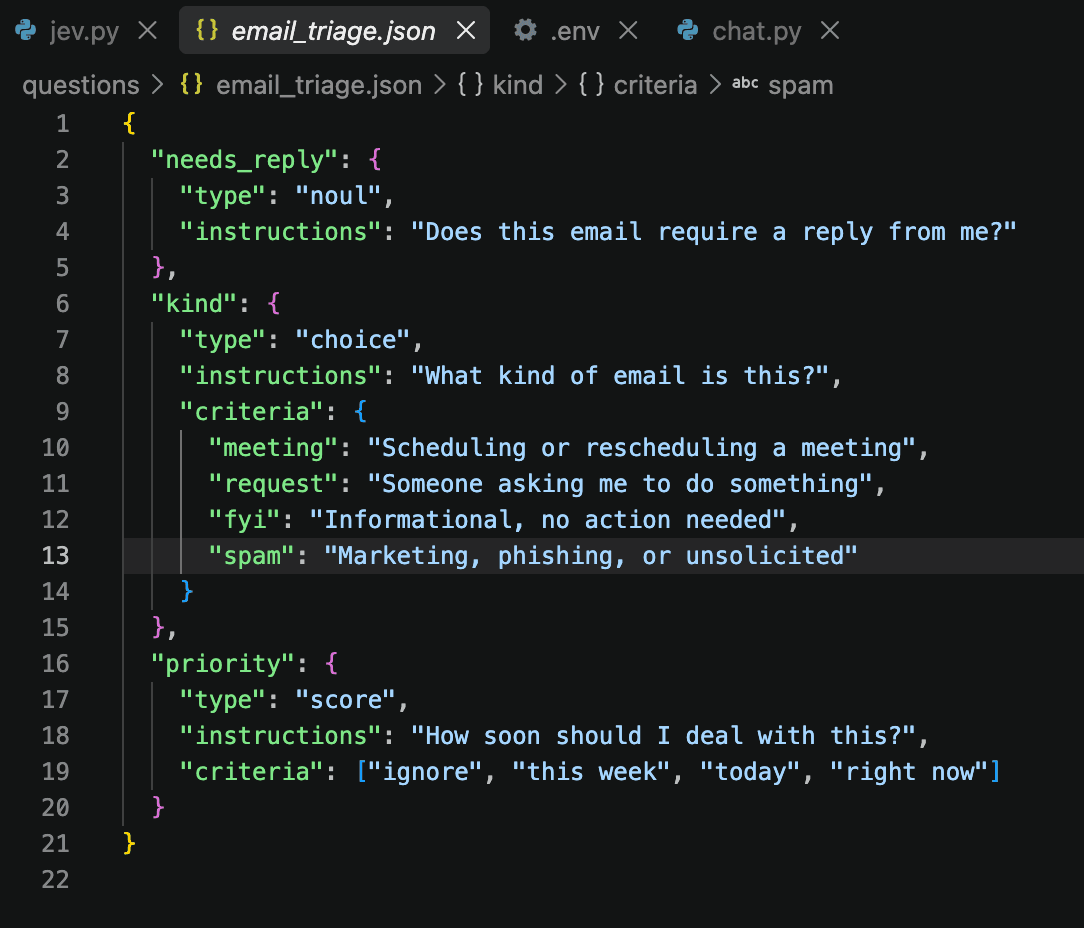 Sample of Jev email triage by Amii Machine Learning EducatorJev will return a choice from those options, together with probabilities. For example, in this test case, Jev has received the following email:
Hello Madison. I wanted to talk to you about a new generative model. It's called JEV and it's super fast at making small decisions. It is also very cheap. I built an app around it which can showcase some of its capabilities. Let me know when we can chat on this. Best, Soroush
The way the above application is set up, Jev responds in a probability and category (meeting, request, fyi, or spam). Due to Jev’s decision primitive, the model can only categorize into the four given classifications, the model cannot invent a fifth email category, therefore, it cannot hallucinate. However, this does not mean Jev cannot be incorrect. In this case, Jev is 78% sure that this email is a meeting type, and is 14% sure it is a request. This example shows that although Jev does not hallucinate, it is not a guaranteed match between the output and the defined structure. Think of it like a multiple choice question, a student can select A, B, C, or D, but cannot invent option E. The student is still able to select the incorrect answer. Jev could mistakenly classify a meeting request as spam while producing a perfectly valid output.
Application
What types of workplace decisions would Jev be best utilized?
It depends on the workplace and the person’s role. Jev is most relevant when a task involves repeatedly evaluating information against clearly defined options or criteria. For example:
Customer Support: Classify requests, route them to the appropriate team, and identify cases that may need specific attention.
Project Management: Categorize incoming feedback, score issue urgency, and flag messages that need follow-up.
Education and Training: Classify learner questions by topic, route them to relevant resources, or flag responses that may need an instructor’s review.
Software Development: Decide whether an agent should search documents, query a database, call a particular tool, or pass a request to a more capable reasoning model.
Explore more:
Want more articles like this?
Sign up for our AI Literacy for Everyone platform and with your annual subscription you'll get:
Four Core Courses:
Machine Learning Foundations 1: Getting Started with AI
Machine Learning Foundations 2: Strategy, Risk and Responsible AI Integration for Business
Responsible AI 1: Navigating Innovation in Practice
Responsible AI 2: Governance and Scaling for Leaders
Weekly "AI in the News" articles discussing the most recent updates and trends
Unlimited access to 100+ new modules added each year
One annual subscription with unbeatable value
Just $139 CAD annually. Group discounts available.
Stay in the loop
Sign up for regular email updates from Amii, including news and events, new podcast episodes, research updates, and more. You can update your email preferences or unsubscribe at any time.